A Corner That Holds You: Settling Into Online Therapy So It Feels Like Yours
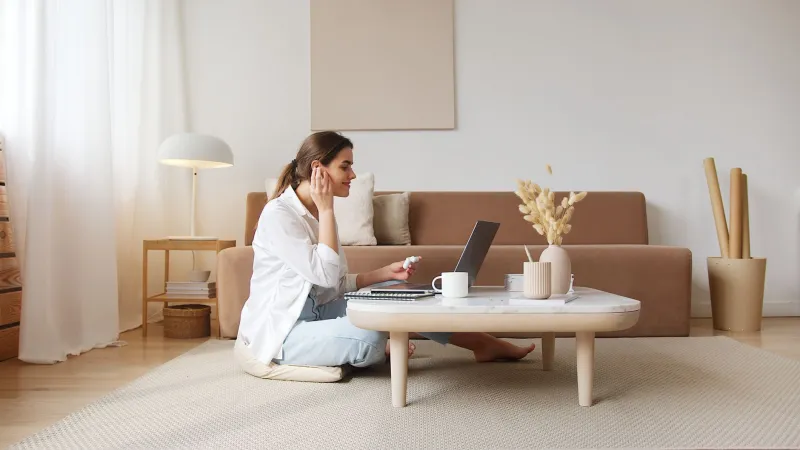
Online therapy often starts with a practical sigh of relief. No commute. No waiting room. No trying to remember where you parked. You open a laptop, click a link and there is your therapist. Convenient, yes. But convenient is not quite the same as contained.
For plenty of people, the first few online sessions feel a bit like a meeting. There is a screen, a diary slot and perhaps a small voice in your head asking whether you are doing it properly. The good news is that a therapy space does not have to be a whole room with a heavy door and a box of tissues. It can be a corner, a chair, a pair of headphones and a handful of cues that tell your nervous system: this matters, and for the next fifty minutes, I am here.
Start with the square metre around you
You do not need to redesign your home. You need one reliable spot. A chair you associate with sessions rather than scrolling. A cushion. A glass of water. Maybe a lamp instead of the overhead light that makes everything feel like a dentist’s waiting area.
Think about what is behind you on camera. A plain wall, a curtain, a door — anything that is not a pile of laundry or a very personal calendar. It is not about looking polished. It is about reducing the number of things your brain has to process while you are trying to say something difficult.
Headphones help more than you might expect. They make the therapist’s voice feel closer and soften the background life of a shared flat or a terraced house. If you live somewhere busy, a white-noise app or a fan can blur the edges of other people’s conversations. None of this is fussy. It is just a bit of scaffolding.
Privacy that actually works
Online therapy asks a lot of your environment. If you live with others, privacy can be the difference between a useful session and an hour of careful half-sentences. It is worth being practical rather than optimistic.
Book the time when the house is usually quietest. Put a note on the door — something boring like “work call, back at 4” often works better than a detailed explanation. Use headphones. Close the curtains if you are worried about being seen. If you are in a shared house, can you use a bedroom, a study, a car parked safely somewhere private, or a garden room? Some clients use a local library meeting pod; others sit in a parked car with the engine off. It is not glamorous, but it can be contained.
And if privacy is genuinely impossible, tell your therapist. You do not have to pretend. They may help you adjust the session — perhaps shorter check-ins by phone, audio-only work, or a different time. The format can bend more than you think.
Build a threshold, not just a login
The strange thing about online therapy is that there is no journey between ordinary life and the session. You might be answering an email one minute and talking about your childhood the next. A small threshold ritual helps mark the change.
Try this: two minutes before the session, close the tabs you do not need, put your phone on do not disturb, and make a drink. Sit down in your therapy spot. Notice the chair underneath you. Take one slow breath. Then open the link.
It sounds almost too simple, but repetition is the point. The same mug, the same cushion, the same short pause tells your body that this is different from a work call. You are not just logging on. You are arriving.
When the screen feels distant
Sometimes online therapy feels flat. The words are there, but the connection is not. You might find yourself watching your own face in the corner of the screen, or wondering whether your therapist can really see you.
Say it. “I’m finding it hard to feel connected today.” “I keep getting distracted by the screen.” “Can we slow down?” A good therapist will not be offended. They may move closer to the camera, change the pace, check in more often, or suggest you look away from the screen while you talk. Sometimes turning the camera off for a few minutes helps. Sometimes it does not, and that is useful to know too.
You can also give your hands something to do — hold a mug, a soft toy, a folded blanket. Let your eyes move around the room rather than fixing on the little rectangle of your own face. The screen is a tool, not the whole relationship.
When real life interrupts
Doorbells. Deliveries. A child who has decided now is the moment for a very important question. A dog who has heard something outrageous. These things happen, and they happen in online therapy more visibly than in a clinic.
It helps to have a rough plan before the session. Tell your therapist at the start if interruptions are likely. Put a sign on the door. Keep headphones nearby. If something does happen, you do not have to perform calm. A brief “sorry, one second” is enough. Most therapists are very used to real life appearing in the background.
If you would rather not have your home on display, you can also talk about what you want the camera to show. You might prefer a blank wall, a blurred background, or to keep the camera angled so only your face is visible. None of that undermines the work. It just makes the space more bearable.
Talk about the format
Online therapy works best when the format is part of the conversation rather than a silent rule. You are allowed to ask for adjustments. Could you start with a few minutes of grounding? Could you have a break halfway through? Would audio-only feel easier on a hard day? Could your therapist send a short message afterwards with the key points, if you find it hard to remember?
These are not awkward requests. They are part of building a space that fits you. If something about the setup is making it harder to engage, say so early. A good therapeutic relationship can hold that conversation.
At Valentina Hamilton Therapy, the aim is calm, confidential therapy for clearer days — and that includes the practical setup around the screen. The room online may be small, but it can still be yours.
A space can be made of attention
Online therapy will not feel identical to sitting in a room with your therapist. That is true. But it can still be real, contained and deeply useful. The space is made as much of attention as it is of walls: the same chair, the same ritual, the honesty about what is happening in the background, and the willingness to say when the screen feels too far away.
So before your next session, choose your corner. Make your drink. Put the world on hold for a moment. You do not need a perfect room. You just need somewhere you can arrive.